
Custom Steering Wheel: Is It Legal? Airbag and Technical Inspection
مشاركة
This is the question that stops most projects: is a custom steering wheel legal in France, and what happens to the airbag? Here is what the road code says, what the technical inspection checks, and what your insurer will say.
The essentials in 30 seconds
- Changing your steering wheel is not prohibited in France.
- What matters is keeping the original airbag and its connectors.
- A removed or disconnected airbag means failing the technical inspection.
- A wheel that keeps the airbag, horn and controls remains compliant.
- Tell your insurer: an undeclared modification can reduce your payout.
What the regulations say
No French law prohibits replacing the steering wheel of a passenger vehicle. What is regulated is keeping the safety equipment that was present when the vehicle was type-approved.
In practice, a vehicle delivered with a driver's airbag must keep a working driver's airbag. This is the principle that guides everything else.
The distinction is essential: the law does not care about the shape, material or color of your steering wheel. It cares that the safety components work as they did originally.
The airbag question
There are two very different approaches on the market.
The wheel rebuilt from the original
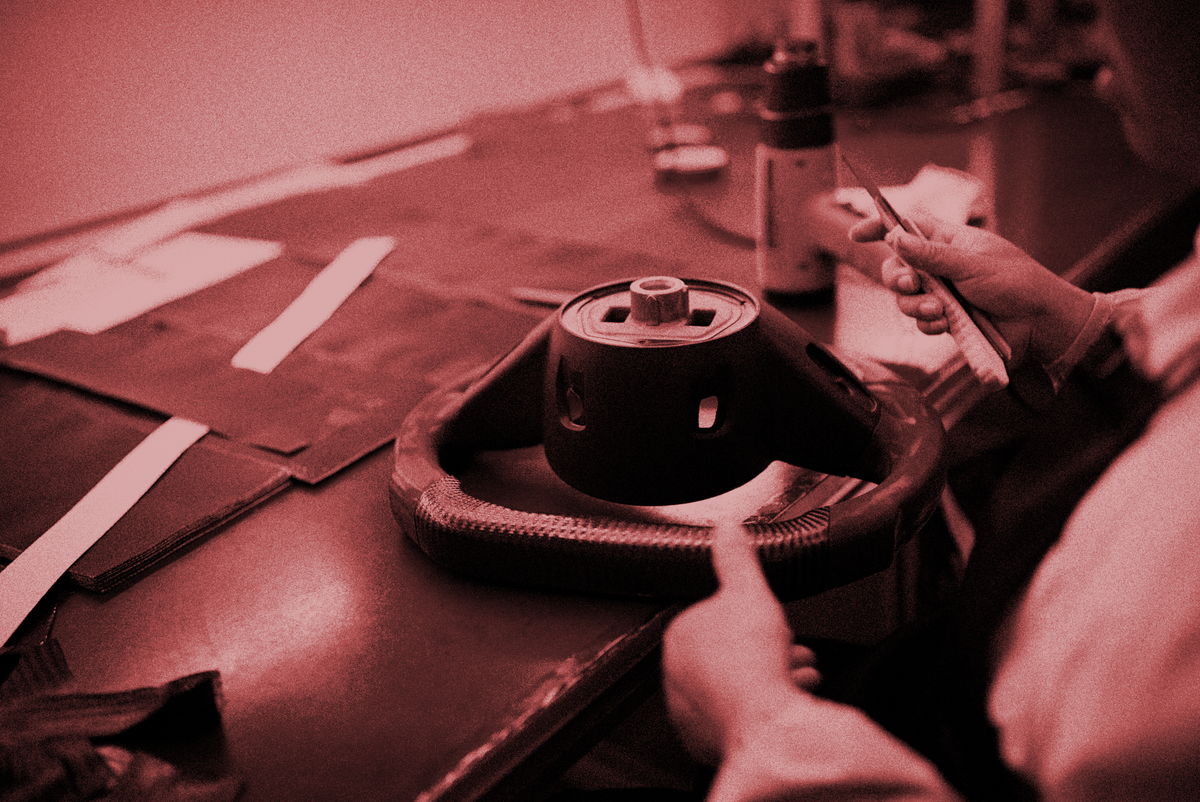
Your original wheel, or an identical one, is removed, refitted, trimmed in carbon or Alcantara, then reinstalled. The airbag, base plate, connector and steering wheel controls remain the manufacturer's.
This is the only approach that fully preserves the safety chain.
The universal sport wheel
A racing wheel with a universal hub has no airbag. Fitting it to a road car requires disabling the system, which triggers the dashboard warning light and counts as a defect at the technical inspection.
| Checkpoint | Wheel rebuilt from original | Universal wheel without airbag |
|---|---|---|
| Driver's airbag | Kept and functional | Removed |
| Dashboard warning light | Off | Permanently on |
| Technical inspection | Compliant | Major defect |
| Steering wheel controls | Kept | Lost |
| Insurance | To be declared, no issue | Risk of coverage refusal |
What the technical inspection actually checks
The inspector does not remove the steering wheel. They look at three things:
- The airbag warning light on the dashboard, which must come on when the ignition is switched on and then go off.
- The absence of abnormal play in the steering column.
- That the horn works, often built into the steering wheel.
A custom wheel that keeps these three points passes the technical inspection with no remarks. You can check this even before booking an appointment: if the airbag light goes off normally after starting the car, the system is recognized.
What about insurance?
A cosmetic modification that affects neither power nor structure generally does not lead to any surcharge. It should still be reported, because an insurer can cite an undeclared increase in risk to reduce its payout.
An email to your advisor, with a photo, is enough in most cases. Keep the written reply.
The three costly mistakes
Disconnecting the airbag "just to try"
The control unit records the fault. Even after reconnecting, the warning light may stay on until it is reset at a workshop.
Buying a wheel without a compatible connector
Airbag connectors differ from one manufacturer to another, and sometimes from one year to another on the same model. A compatible wheel is one whose connector is the one on your vehicle.
Losing the steering wheel controls
Cruise control, phone, paddles: on recent vehicles, these controls go through the steering wheel's base plate. A wheel rebuilt from the original keeps them.
Frequently asked questions
Is a custom steering wheel prohibited in France?
No. What is regulated is keeping the airbag and the original safety equipment.
Does the technical inspection reject a carbon wheel?
No, provided the airbag works and the warning light stays off. The wheel's material is not a criterion.
Is a special approval required?
Not for a wheel rebuilt from the original, which keeps the vehicle's approved components.
What happens in an accident?
If the original airbag is kept and functional, it deploys normally.
Do I need to tell my insurer?
Yes, in writing. A declared cosmetic modification generally does not lead to any surcharge.
Read next