
Worn steering wheel, shiny leather, flattened Alcantara: what a steering wheel retrim can fix, and what it cannot
Share
Over time, the contact areas can smooth off, mark up, or lose their texture. A steering wheel retrim often restores a clean feel and finish, provided surface wear is clearly separated from deeper issues.
The essentials in 30 seconds
- Identify the right signs of wear before deciding on a steering wheel retrim
- Tell the difference between a tired surface and a foam or frame issue
- Understand what refurbishment can correct on the outer trim
- Prepare removal properly and leave refitting to a professional
- Choose the right materials for real use and day-to-day care
How to recognise surface wear
Leather that has gone unusually shiny is not always deeply damaged. It may simply have been polished by friction, hands, unsuitable cleaning products, or built-up residue.
Flattened Alcantara follows a similar pattern. The fibres lie down, the surface looks different, and the feel becomes flatter, especially in the areas used most.
These signs often point to wear in the outer covering rather than a structural fault. That is exactly the kind of case where a well judged refurbishment makes sense.
| Sign | Likely cause | Action |
|---|---|---|
| Shiny leather | Polished surface | Retrim may be suitable |
| Flattened Alcantara | Fibres pressed down | Refurbishment may suit |
| Collapsed grip contour | Tired foam | Inspection needed |
| Damaged control | Related component | Check case by case |
What refurbishment can fix, and what it cannot
Retrimming works first on the outer layer. It can replace a worn covering, revise the finish, change the material, and refine details such as a flat bottom, a twelve o’clock marker, stitching, or the shape of the hand contact areas.
By contrast, crushed foam, a distorted frame, or damaged integrated controls need separate assessment. If the original base has a structural issue, work on the trim alone is not enough.
The starting point is always the original base. The original airbag kept also means the vehicle’s fitting and checking logic must be respected.
That is why a proper assessment looks at both the visible surface and the base underneath. A tidy finish should never hide a deeper issue in the original part.
Choosing the right material for how you drive
The covering material affects feel, appearance, and maintenance. Nappa leather gives a softer grain, perforated leather brings a more technical look, and an alcantara steering wheel gives a drier, more matte contact.
For inserts, woven carbon and forged carbon do not express the same style. Woven carbon gives a regular and readable pattern, while forged carbon has a more broken, more mineral visual effect.
The right choice depends above all on real use. Daily driving, hands that are often damp, or a search for a more direct feel do not lead to the same material combinations.
Preparation, checks, and refitting
Before any refurbishment, the overall condition of the original part needs to be checked. The aim is to identify clearly what relates to the covering, the shape, the controls, or the base itself.
- Check the wear: look for shiny areas, flattened fibres, marked creases, and any deformation.
- Inspect the base: check the foam, the frame, the spokes, the controls, and the paddles if the vehicle has them.
- Define the configuration: choose the materials, design, stitching, visual marker, and desired shape according to the compatible base.
- Use a professional for refitting: leave removal and refitting to a specialist used to working on original vehicle parts.
Professional refitting remains the right approach. It helps keep to the removal procedure, reconnect the fitted elements correctly, and validate the final installation in proper conditions.
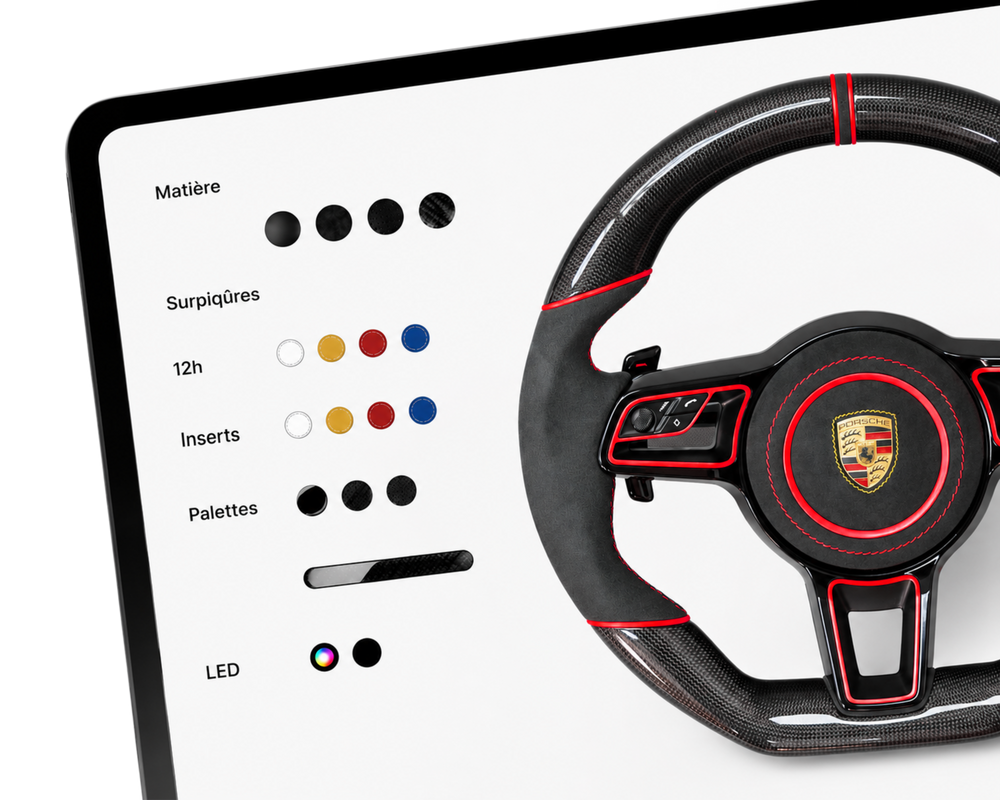
In our workshop, each custom steering wheel is built to order from a compatible original base and the choices made in the online configurator. The pre-dispatch check, recorded and dated, completes that process.
Common mistakes
Confusing maintenance with deep stripping
Aggressive cleaning can increase shine on leather and tire some surfaces early. It is better to use care suited to the material than products that strip too hard.
Expecting too much from the outer trim alone
A newly trimmed surface does not automatically correct collapsed foam or a distorted structure. The visible finish and the real condition of the base must be separated before starting any refurbishment.
Underestimating the refitting process
Even when the part looks simple to remove, the built-in elements and the original airbag kept require careful work. Refitting should be handled by a professional.
Frequently asked questions
Does shiny leather always mean it needs replacing?
No. A strong shine can point to surface wear without deeper damage to the original base. That often makes it a suitable case for a steering wheel retrim.
Can flattened Alcantara look sharp again?
Yes, if the issue mainly concerns the surface rather than a damaged base. In that case, refurbishment allows a fresh material and a clean finish.
Can crushed foam be corrected at the same time?
It depends on the condition of the original base. If the deformation affects the support underneath, a simple change of outer covering will not solve everything.
Can I fit it myself?
Removal and refitting should be left to a professional. That is the right way to respect the original assembly and check the whole unit during the work.
Steering wheels by brand
Model guides